
This display case is dedicated to sixth-generation home consoles, as well as handheld consoles from various generations. It also includes other video game accessories, such as a steering wheel, pedals, and various joysticks. Finally, there are a couple of PC troubleshooting kits.
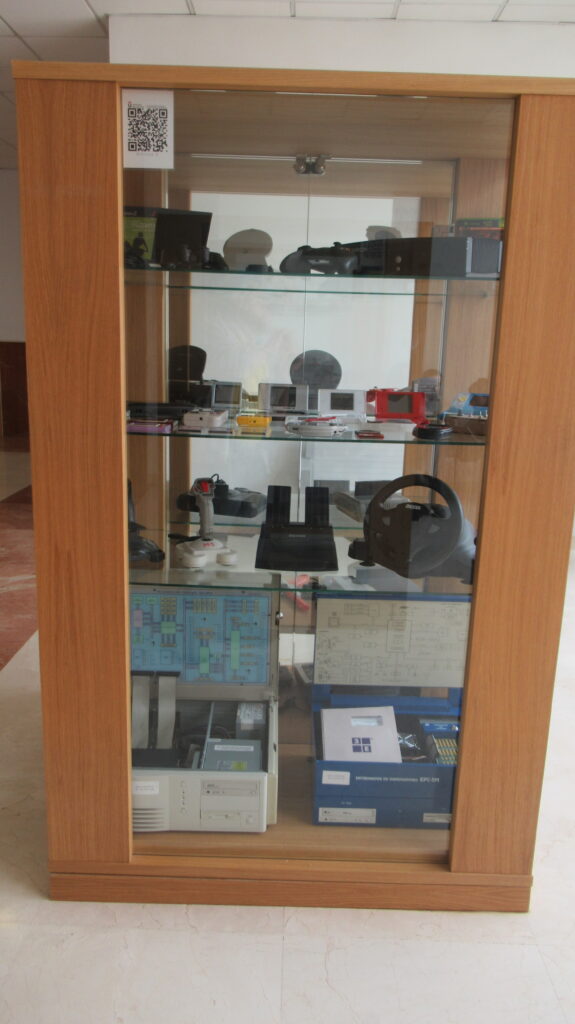
Recall that in the previous display case we found two examples of the so-called sixth generation of video game consoles (1998-2005): the Sega Dreamcast and the Nintendo GameCube. On the top shelf of this display case, we can see two more representatives of this generation. On one side, Sony, which had already established itself as the third major player in the sector, released the PlayStation 2 (PS2) in 2000. The console that can be seen on the left of the shelf is the PS2 Slim, a streamlined version that appeared in 2004.
A new player emerged in this generation among video game console manufacturers: Microsoft, through its Gaming division. The American company released its Xbox in 2001 (on the right of the shelf). One of its best-selling games, if not the best-selling, is the first-person shooter “Halo 2.”
Since the end of the sixth generation of video game consoles, three more generations have been added, making the current generation the ninth. In all cases, the companies competing for the market are Sony, Microsoft, and Nintendo, as Sega abandoned console manufacturing in the early 2000s. We do not have any examples of home consoles from these generations in our Museum.

The second shelf from the top houses handheld video game consoles from different generations. Representing the second generation (1976-1984), we have two Nintendo Game & Watch handhelds (Chef from 1981 and Snoopy Tennis from 1982). There is some debate in the literature as to whether they are truly “video game consoles” or “electronic games,” since they are actually based on a liquid crystal display (LCD) rather than a video screen. They also lack the ability to change games. However, we believe they deserve to be included here due to their historical significance prior to the NES of 1983.
Skipping the third generation, we go straight to the fourth (1987-1994) with Nintendo’s pale gray Game Boy (1989) and Sega’s Game Gear (1990). Both consoles used small, interchangeable cartridges. If you haven’t already, you should watch the movie Tetris (2023), which tells the story of how the legendary Russian game of falling blocks came to the Game Boy (in the centre-left of the shelf there are three Game Boy cartridges, and one of them is Tetris).
From the fifth generation (1993-1999), we only have the Nintendo Game Boy Color (1998), in a striking canary yellow. It’s displayed next to its older sibling, the original Game Boy, and you can see that it’s smaller and easier to handle.
Regarding the sixth generation (1998-2005), we have the 2001 Game Boy Advance, along with a couple of game cartridges (centre of the display case), and the 2003 Game Boy Advance SP, which is foldable and smaller (on the back left of the shelf). Both consoles are from Nintendo.
From the seventh generation (2004-2010), we have three versions of the Nintendo DS (centre back of the shelf). These are foldable consoles with dual screens, operated with a stylus or pointer. They are the original Nintendo DS (2004), in gray, the DS Lite (2006), in white, and the DSi (2008), in red. Alongside them is the racing game Mario Kart DS. As you can see, the game cartridges have been replaced by a simple, small memory card. Alongside these Nintendo consoles, we can also highlight the VTech MobiGo (2010), an educational console for children, with a built-in keyboard.
Finally, from the eighth generation (2011-2020) we can highlight the Nintendo 2DS (2013), also with two screens, but not foldable (centre of the shelf).
Other handheld consoles that can be found on this shelf include a mini arcade machine (left), a Tetris console made with a transparent case that is sold in pieces for electronics enthusiasts (left), an electronic Sudoku (right), and a home console with the game Pong from a workshop at the 2019 AtariMad event.

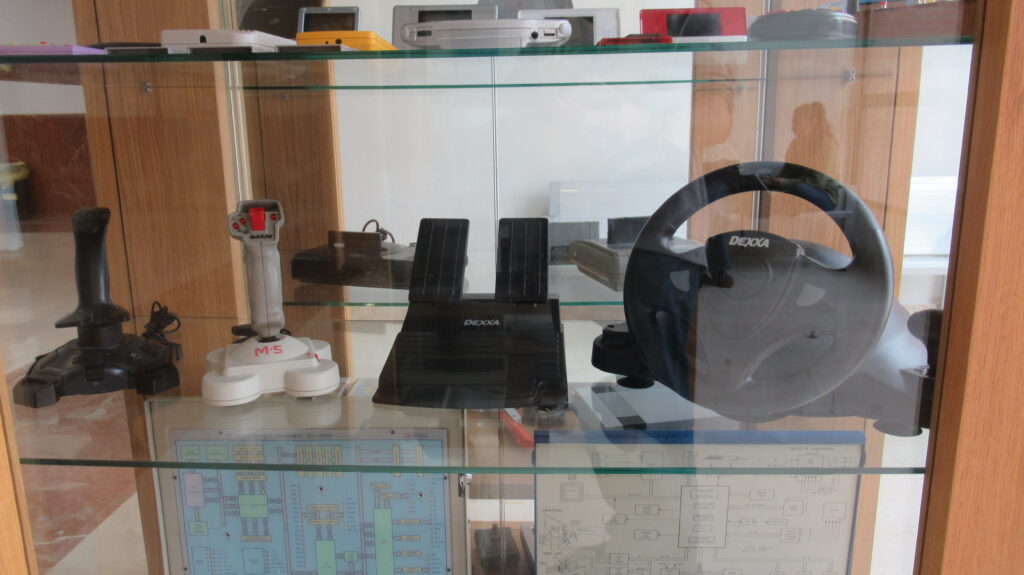
On the second shelf from the bottom, we display various peripherals specifically designed to enhance your gaming experience. These include a pair of joysticks (left) and a steering wheel and pedals for racing games (right).
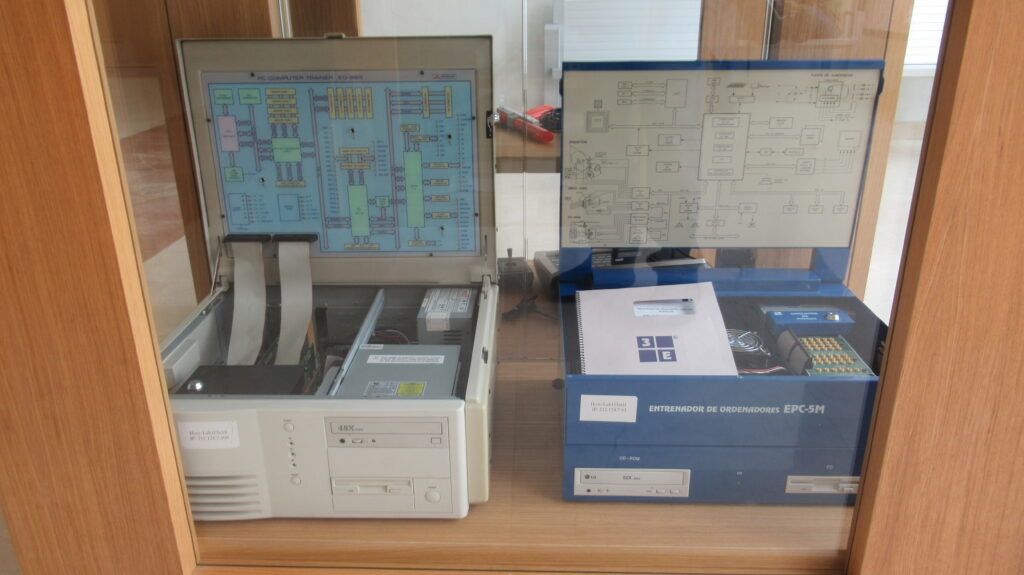
With the lower shelf, we shift gears completely and leave the world of video games behind. Here we display two fault trainers, one from Promax (left) and the other from 3E (right). Both have their casings open to reveal fascinating diagrams of their various subsystems. These are ordinary computers that allow for the simulation of computer errors and failures of all kinds. Using a set of switches, the fault can be set to a keyboard failure, a hard drive failure, a screen failure, and so on. This type of equipment can be used to train future computer technicians who will have to repair real-world faults in their professional lives. Specifically, in the 2000s, they were used in the PC Lab course offered to students in programs such as Computer Systems Engineering or Management Information Systems Engineering at the Móstoles campus of our University.
Below, we list the detailed contents of each shelf in this display case:
| * Sony PlayStation 2 Slim video game console, with controller, memory card, boxes for the video games “Jeremy McGrath Supercross World” and “Roland Garros French Open 2003”, and wireless accessories for the video game “Guitar Hero” * Microsoft Xbox video game console, with controller, and box for the video game “Halo 2” |
| * Nintendo Game & Watch Snoopy Tennis Handheld Console * Nintendo Game & Watch Chef Handheld Console * Nintendo Game Boy Handheld Console (beige) * Nintendo Game Boy Color Handheld Console (yellow) * Nintendo Game Boy Advance Handheld Console * Nintendo Game Boy Advance SP Handheld Console * Nintendo DS Handheld Console (gray) * Nintendo DS Lite Handheld Console (white) * Nintendo DSi Handheld Console (red) * Nintendo 2DS Handheld Console (red and white) * Sega Game Gear Handheld Console * Handheld Video Game Console in an electronics kit with “Tetris” and other pre-loaded video games (transparent) * MobiGo Educational Handheld Video Game Console * Sudoku Challenger Handheld Video Game Console * AtariMad Pong Handheld Video Game Console * Space Invaders Tiny Arcade Handheld Video Game Console * “Mickey Mouse II” Video Game (Nintendo Game Boy) * “Tetris” Video Game (Nintendo Game Boy) * Video Game “Adventure Island” (Nintendo Game Boy) * Video game “Driven” (Nintendo Game Boy Advance) * Video game “Pokémon Ruby Edition” (Nintendo Game Boy Advance) * Video game (box and memory card) “Mario Kart DS” (Nintendo DS) * Video game “Sonic the Hedgehog Pinball” (Sega Game Gear) * Video game “SpongeBob SquarePants: Defending the Secret Formula” (MobiGo) * Video game “Cars 2” (MobiGo) |
| * Logitech Attack 3 Joystick * Quickjoy M-5 SV-201 Joystick * Dexxa Wheel Pedal (pedals) * Dexxa Steering Wheel (steering wheel) |
| * Promax Troubleshooting Trainer, model EO-865 * 3E Educational Electronic Equipment PC Repair Trainer, model EPC-5M, with application practice booklet containing the EPC-5 ISA/PCI and EPC-5 modules |