
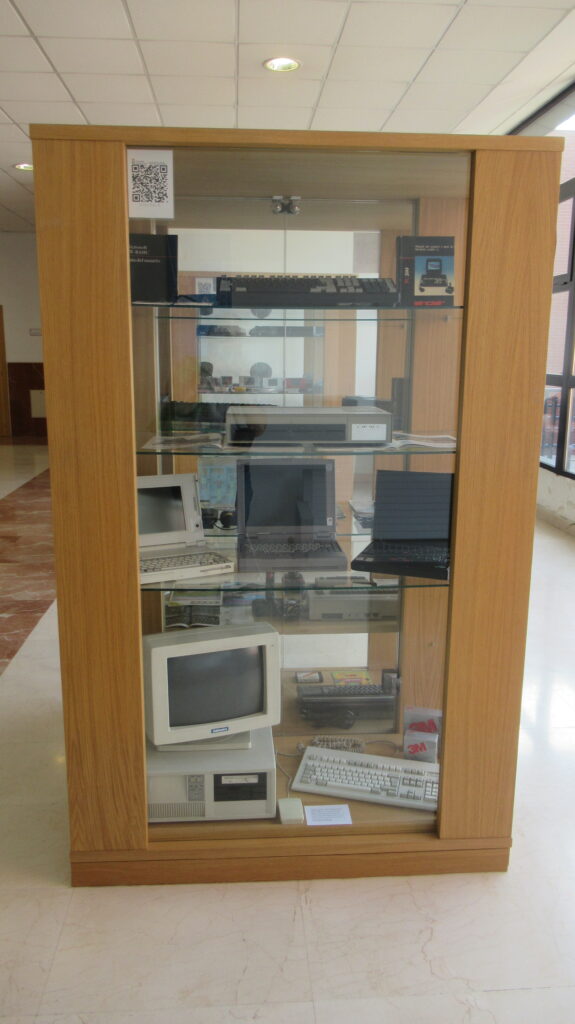
This display case is dedicated to various PCs from the 80s and 90s.
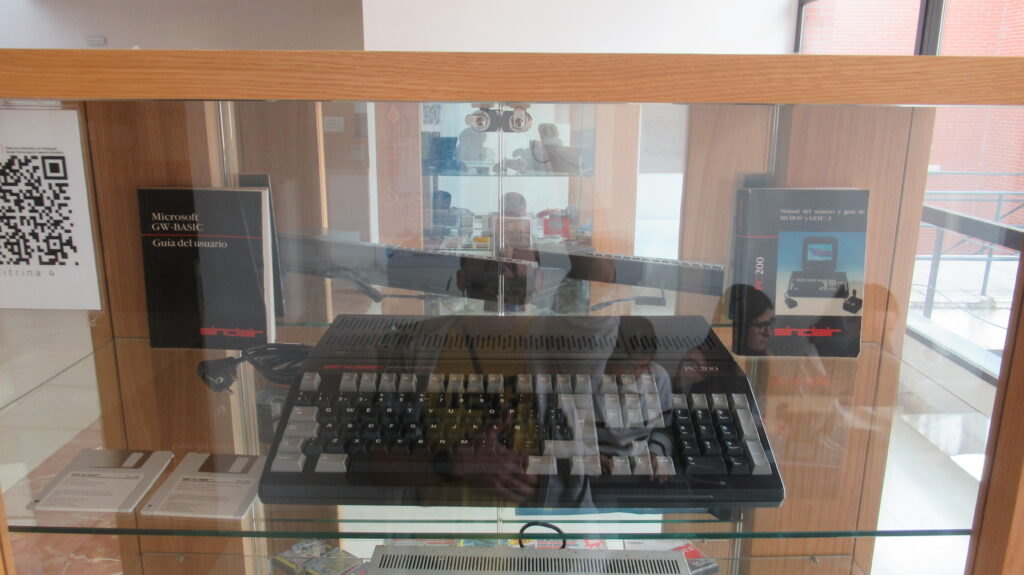
The top shelf displays a Sinclair PC 200 (1988). This was an attempt by Sinclair, the company behind the successful ZX Spectrum, to enter the world of IBM PC-compatible clones. However, this computer was released slightly after Amstrad‘s acquisition of Sinclair (1986), so some computers bear the Sinclair logo and others the Amstrad logo. The computer shown here has the Sinclair logo, but when turned on, it displays both Sinclair and Amstrad logos.
The PC 200 follows in the footsteps of the Commodore 64 and other computers of the era in that the keyboard is integrated into the tower. It can be connected to a monitor or a television, making it very versatile, and also features a 3.5″ floppy disk drive, as well as connectors for a mouse, joystick, and printer. As you can see, it’s a professional model geared towards business, not so much towards the world of video games.
As a supplement, we have included on this shelf a couple of 3 1/2″ floppy disks: one with the boot disk for the MS-DOS 3.3 operating system and the GW-BASIC programming language, and another with the GEM/3 windowing system. Two user manuals for this computer are also included.
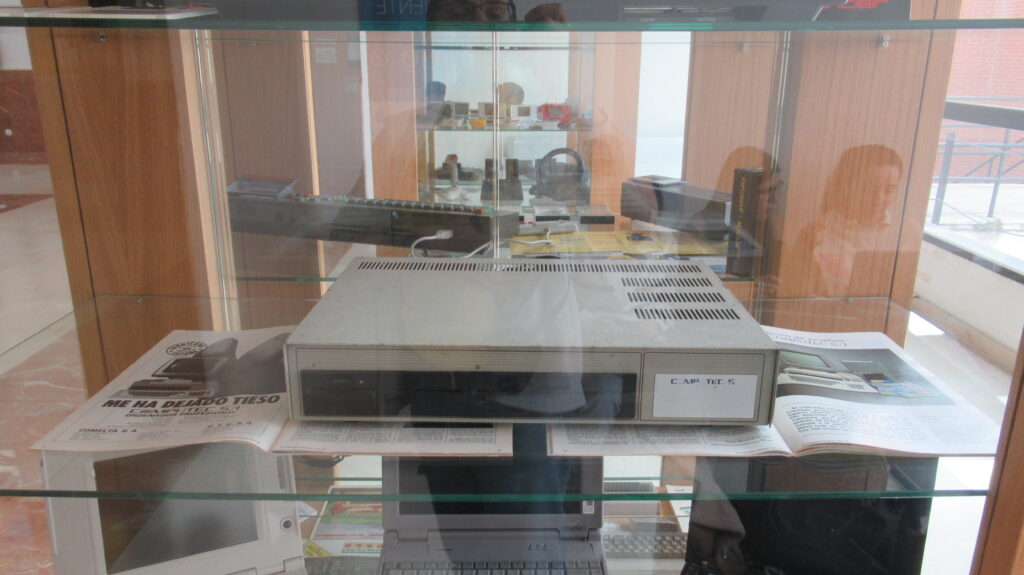
The second shelf from the top contains what is probably the most exotic item in our collection: the Computec S/1 computer from the first half of the 1980s. It was produced by the Spanish company Computer Technology, with circuitry design and manufacturing processes that were 100% Made in Spain. It can be considered Spain’s attempt to compete with IBM PCs at a time when computers were being selected to equip the then-new computer labs in primary and secondary schools across the country, in what was called Project Athena. Although some Computec units were purchased—around 150—the Spanish Ministry of Education ultimately opted for models from other brands such as Olivetti and Investrónica.
The Computec shown here has its name slightly faded on the front. It has two 5 1/4″ floppy disk drives and no hard drive. It’s missing the monitor and keyboard, which function as a terminal; the keyboard would connect to the monitor, and the monitor would then connect to the tower. It only had 64 kB of RAM.
It must be said that the Computec S/1 was not a commercial success. Firstly, due to its high price. An advertisement published in the ABC newspaper in December 1984 showed a price of 450,000 pesetas (around €2,700), ten times more than a Spectrum 48K at 41,900 pesetas (around €250). Secondly, the chosen processor was an 8-bit Zilog Z80, like the one in the ZX Spectrum, and it used the CP/M operating system. It was therefore incompatible with PCs based on the Intel 8088 processor and using MS-DOS. This different architecture and the rise of the PC led to a significant lack of applications, which contributed to its poor reception.
Two copies of the magazine “El Ordenador Personal” (1984-1985) complement this shelf. One features a full-page advertisement for the Computec with the catchy slogan “It blew my mind!” The other contains a 7-page article analyzing the computer’s strengths and weaknesses.
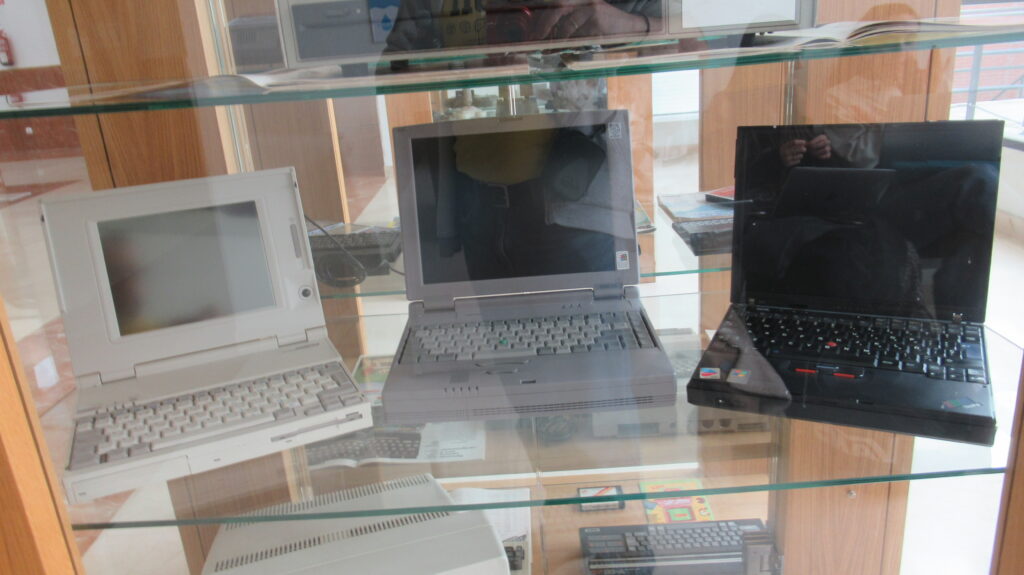
On the second shelf from the bottom, we have three examples of PC laptops (as opposed to the Apple laptops in display case 8). These are a Compaq LTE Lite 4/25C (1994), a Toshiba S320CDS (1996), and a 13-inch IBM ThinkPad (2004). We also happen to have the 14-inch version of the ThinkPad (2002), but it’s not on display.
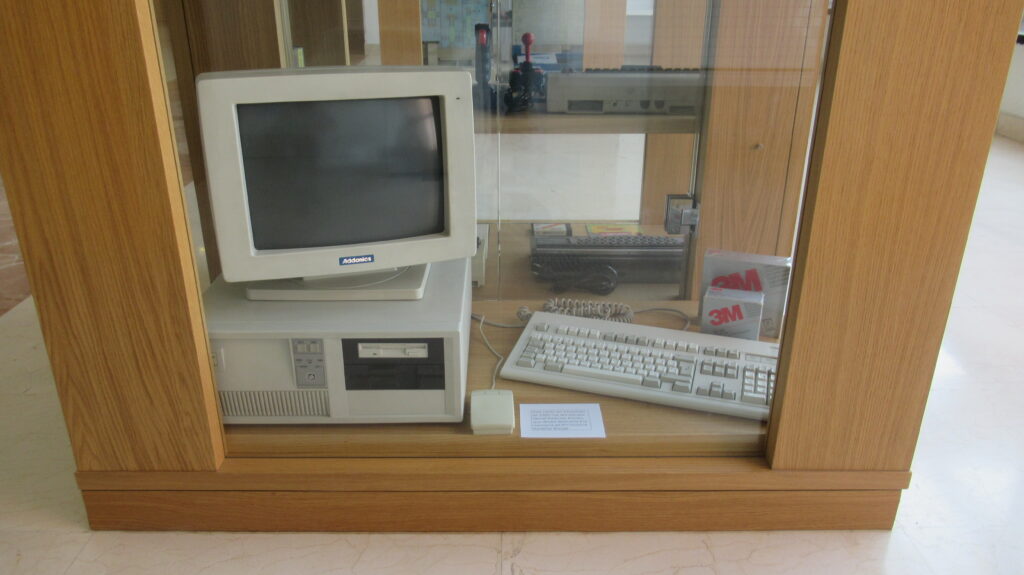
Finally, on the bottom shelf, we find an IBM XT-compatible PC, model Ataio 640 (1989). It includes two floppy disk drives, one 3.5″ and the other 5.25″ (the 3.5″ drive is not original and was replaced with an equivalent one). The monitor is an EGA type. A Spanish-format keyboard completes the setup (this computer did not use a mouse). This computer arrived with a 20 MB hard drive, which was removed because it was damaged, so the computer is functional by loading the MS-DOS 3.3 operating system from a floppy disk.
In the right corner we also show two boxes of 3M brand floppy disks, one of 3 1/2″ and the other of 5 1/4″.
Finally, we can see a 3-button trackball mouse (1991). It is accompanied by a dedication to M.ª Victoria Rodellar Biarge, the former director of the Historical Museum of Computing at the Faculty of Computer Science of the Polytechnic University of Madrid.
Below, we list the detailed contents of each shelf in this display case:
| * Book “Microsoft GW-BASIC User Guide” * Sinclair Professional Series PC 200 computer (integrated all-in-one), with boot disks * Book “MS-DOS and GEM/3 User Manual and Guide” |
| * Computer Technology of Spain computer, model Computec S/1 (tower only) * Advertisement for the Computec S/1 published in the magazine “El Ordenador Personal”, number 23 (1984) * Report on the Computec S/1 published in the magazine “El Ordenador Personal”, number 36 (May 1985) |
| * Compaq LTE Lite 4/25C Laptop * Toshiba S320CDS Laptop * IBM ThinkPad 13″ Laptop |
| * Ataio 640 Superturbo/XT PC computer, with Addonics EGA monitor and keyboard * Two boxes of 3M floppy disks (one 5 1/4″, still in its unopened plastic wrap, and one 3 1/2″) * Sysgration KEM-260 3-button trackball mouse |