
This display case marks the beginning of our museum tour. It is dedicated to various home video game consoles, from the second to the sixth generation. Handheld or portable video game consoles are in the next display case.
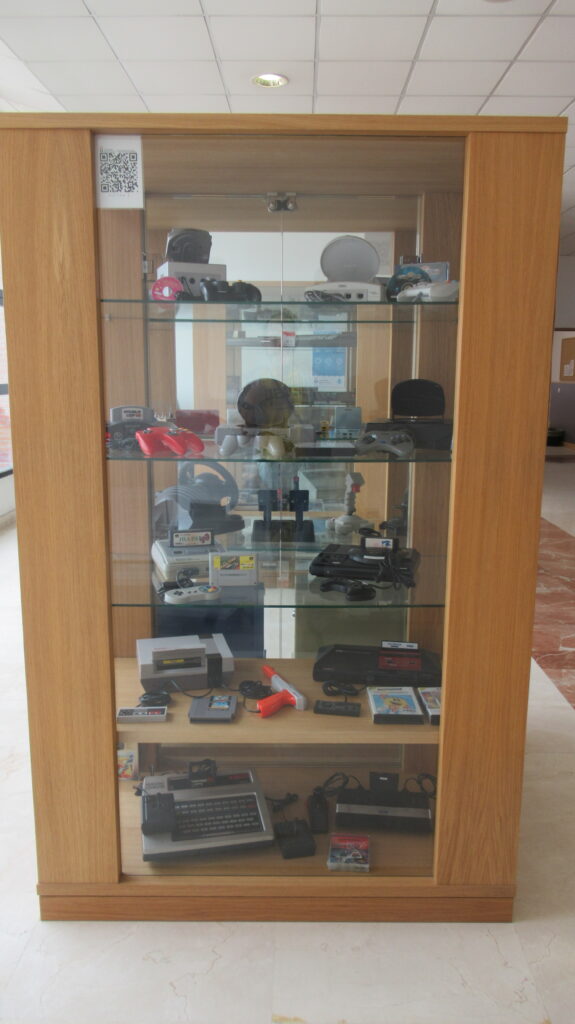
It’s common in the history of video game consoles to use generations as a classification method. Every 5 or 10 years, a new wave of consoles appears with technical and graphical improvements that render the previous one obsolete. The timelines for each generation aren’t exact; they depend on various criteria and can overlap, so they should be considered approximate.
The first video game console on the market, Ralph Baer’s Magnavox Odyssey, was released in 1972. It marked the beginning of the first generation, which we could date from 1972 to 1977. Besides the Magnavox, this generation could include its Catalan clone called Overkal, the Atari Home Pong, Electrotennis, the Coleco Telstar, and others. We don’t have any consoles from this generation, as they are particularly rare collector’s items.
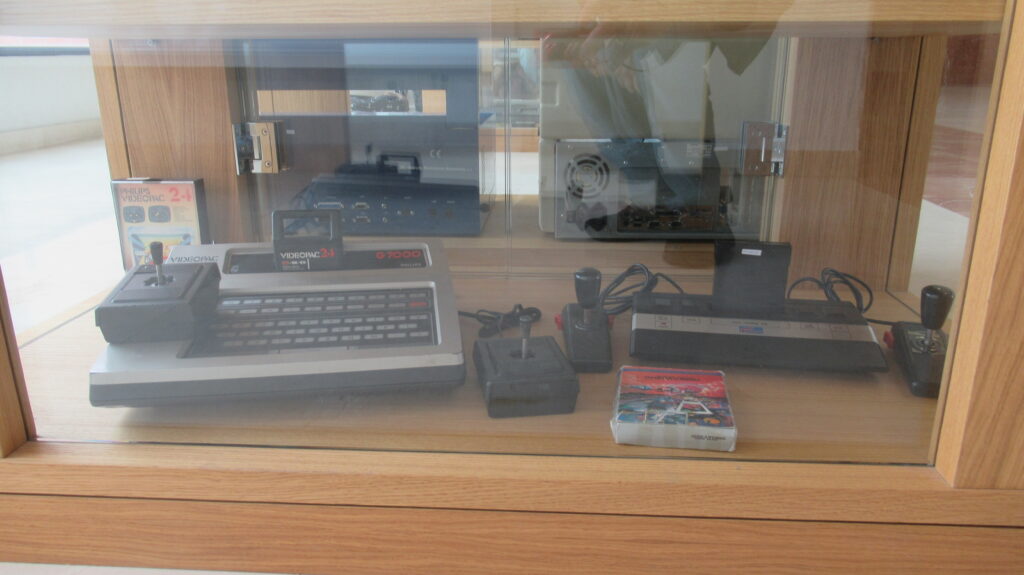
The second generation (1976-1984) began with the Fairchild Channel F and the Atari 2600 (not available). Looking at the lower shelf of this display case, to the left, you can see the Philips Videopac Computer G7000 (1978), which is how the Magnavox Odyssey 2 was known in Europe. The G7000 is characterized by having a pair of joysticks or levers that are wired directly to the machine and cannot be disconnected at any time. The games were released on cartridges in a format that had a practical handle that facilitated the process of inserting or removing them from the corresponding slot. These were games with very basic graphics. The screen remained practically black, except for a few coloured dots that were controlled with the joysticks. Today it would seem very crude, but at that time it was amazing to be able to control a small asterisk on your television screen.
To the right of the G7000, on the same shelf, we find the FunVision, a clone, or rather, compatible, video game console of the Atari 2600. Unlike the Philips console, the joysticks were not wired and could be disconnected for easier storage in their box.
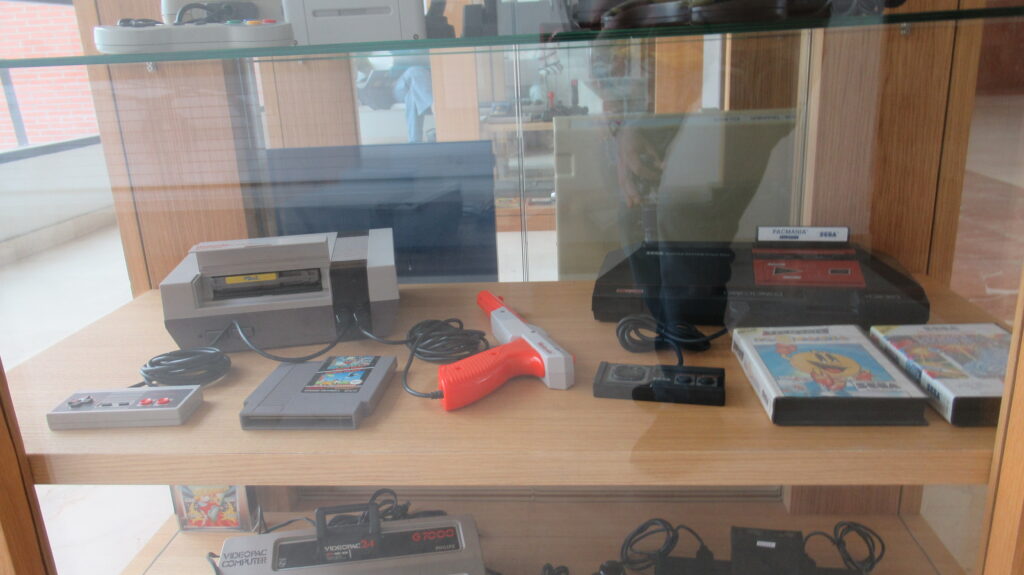
Moving to the second shelf from the bottom, we find a couple of representatives of the third generation (1983-1992). The Nintendo Entertainment System (NES), which can be seen on the left, was released in Japan on July 15, 1983. Joysticks were abandoned and replaced by a rectangular controller with two round buttons and a directional pad for the four directions. The games were two-dimensional, and the most prominent one was “Super Mario Bros.”, although its protagonist, the friendly Italian plumber, had already appeared on screens in earlier arcade machines. This console still used cartridges, which were inserted by opening a small door on the front. Specifically, the NES shown here has “Super Mario Bros. 3” inserted. The “Super Mario Bros.” cartridge, which is shared with the “Duck Hunt” cartridge, can be seen in front of the console. This is a duck hunting game, also a clay pigeon shooting game, which was played with the Nintendo Zapper gun, so distinctive for its striking colours.
Next to the NES, on the right side of the shelf, you can find the Sega Master System, which arrived in stores a couple of years later (1985). It was shorter and longer, black and dark red in colour, although technologically it still used cartridges and a controller similar to (but incompatible with) those of the NES. An example of a Master System game is “Pacmania,” a fun 3D version of Pac-Man, in which the character can jump over the ghosts to avoid them. From the moment this console appeared, a great rivalry was established between the two companies, Nintendo and Sega, which lasted until the beginning of the 21st century.
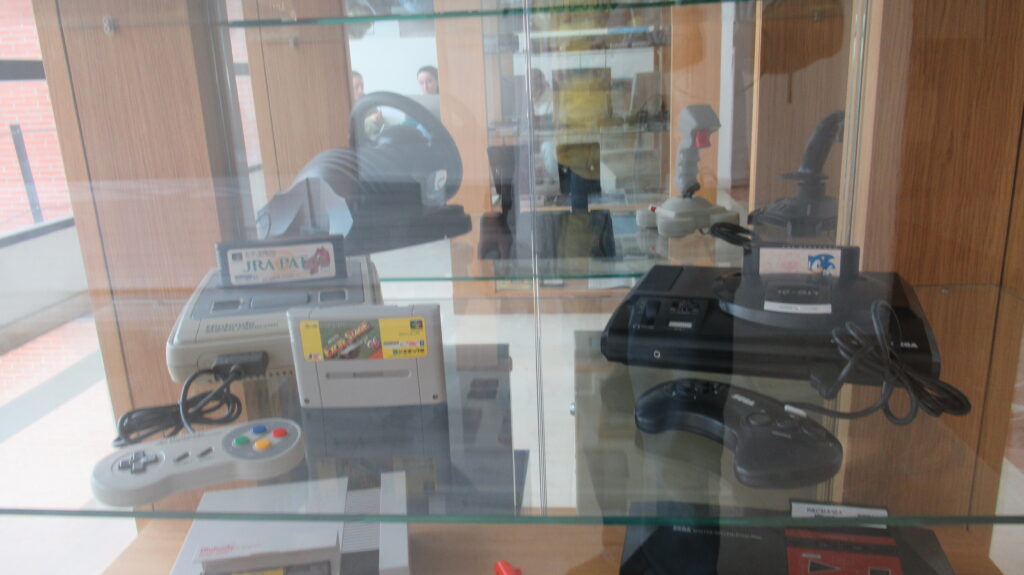
With the third shelf from the bottom, we move on to the fourth generation of video game consoles (1987-1994). This time, Sega beat Nintendo to the punch and released the Mega Drive in the Japanese market in 1988 (it can be seen on the right side of the shelf). This console had better graphics than its predecessor, the Master System, was slightly smaller, and had a larger, more rounded controller, making it easier to hold. One of the most famous games for this console was “Sonic the Hedgehog,” where the famous blue hedgehog had to collect as many rings as possible while rolling into a ball and running through brightly coloured levels.
To the left of the shelf, we find Nintendo’s answer: the Super Famicom, which appeared in Japan in 1990. The following year, it was renamed the Super Nintendo (SNES) in the United States. The version we have on display in our museum is the Japanese one. It was smaller than the original NES, with rounded corners and a top slot for cartridges, thus abandoning the front door. The controller, also rounded, now included four coloured buttons grouped in pairs: A (red) and B (yellow), and X (blue) and Y (green).
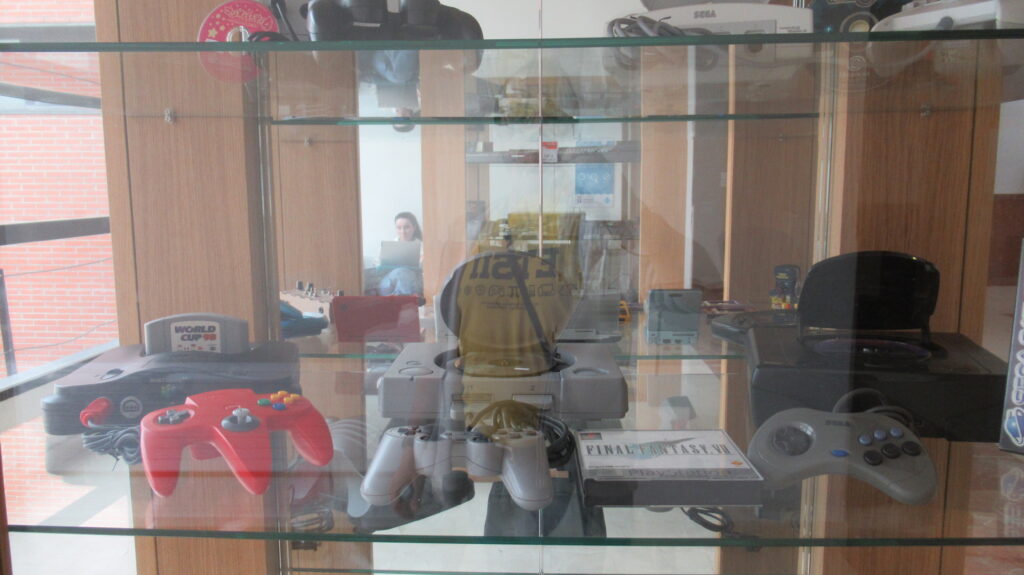
On the second shelf from the top, we can find various examples of the fifth generation of video game consoles (1993-1999). These consoles finally brought three-dimensional polygonal graphics, texture handling, new game formats, and improved sound. Sega once again beat its competitor to the punch and released the Sega Saturn in November 1994 (on the right of the shelf). The major innovation was the abandonment of cartridge-based games and the adoption of optical discs (CD-ROMs), which had greater storage capacity. A notable game for this console was “Tomb Raider,” an action-adventure third-person shooter starring archaeologist Lara Croft. This game launched a worldwide success that, to date, has released more than 20 games for multiple platforms.
Just one month after Sega’s entry, a new player appeared in the video game market: Sony. In December 1994, its PlayStation (PS1) was released in Japan, prominently displayed in the centre of the shelf. Like the Saturn, it was also based on CD-ROM games. Game progress could be saved using 1 MB memory cards. The console’s controller was a game-changer, featuring more buttons. It also adopted the geometric shapes of the square, circle, triangle, and cross, so recognizable today, to differentiate the buttons. One example of a video game for this console is “Final Fantasy VII.”
Two years later, and staying true to its style, Nintendo released the Nintendo 64, which still used cartridge-based games (on the left of the shelf). Unlike its competitors, it had slots for four controllers simultaneously. These controllers also had a distinctive shape with three “handles,” in addition to a small joystick in the centre. Furthermore, for some games, a special kit called the Rumble Pak could be inserted into the controller to add vibration effects.
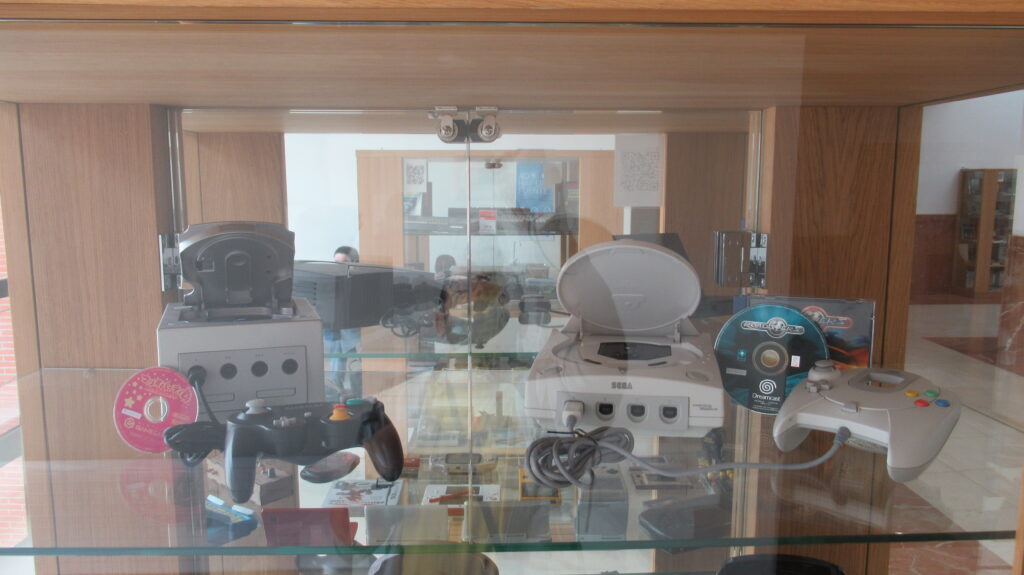
Finally, on the top shelf, we see a couple of examples from the so-called sixth generation (1998-2005). Note that this generation continues in the next display case. In 1998, Sega released the Dreamcast (on the right). This was the company’s last console before its crisis at the end of 2000, which had been brewing for several years and led to its withdrawal from the industry.
For its part, Nintendo released the GameCube in 2001 (on the left of the shelf). It stood out not only for its distinctive cube shape but also for abandoning cartridge-based games. It adopted smaller-format CD-ROM optical discs (8 cm in diameter compared to the 12 cm of a standard CD). As an example of a game for this console, we can show “Mario Party 4,” the fourth installment in the “Mario Party” franchise that began with the Nintendo 64.
Below, we list the detailed contents of each shelf in this display case:
| * Nintendo GameCube video game console, with controller, with CD-ROM of the video game “Mario Party 4” (supported) * Sega DreamCast video game console, with controller, with box and CD-ROM of the video game “Roadsters” (supported) |
| * Nintendo 64 video game console, with controller, with cartridge of the video game “World Cup 98” (connected) * Sony PlayStation video game console, with controller, with box and CD-ROM of the video game “Final Fantasy VII” (connected) * Sega Saturn video game console, with controller, with box and CD-ROM of the video game “Tomb Raider” (connected) |
| * Nintendo Super Famicom video game console (Japanese equivalent of the Super Nintendo), with controller, with cartridges of the video games “JRA PAT” (connected) and “Excite Stage ’95” * Sega Mega Drive video game console, with controller, with cartridge of the video game “Sonic The Hedgehog” (connected) |
| * Nintendo Entertainment System (NES) video game console, with controller, with combined cartridge of the video games “Super Mario Bros.” and “Duck Hunt” and cartridge of the game “Super Mario Bros. 3” (connected), with Nintendo Zapper light gun * Sega Master System video game console, with controller, with box and cartridge of the video game “PacMania” (connected) and with box of the video game collection “Arcade Smash Hits” (“Centipede”, “Missile Command”, “Breakout”) |
| * Philips Videopac Computer G7000 video game console, with two controllers, box and cartridge of the video game “Flipper” (connected) * FunVision Home Computer Game video game console (compatible with Atari 2600), with two controllers, box and cartridge of the video game collection “Donkey Kong”, “Kaboom”, “Pit Fall”, “Mafia”, “River Raid”, “Basketball” and “Frogger” (connected) |