
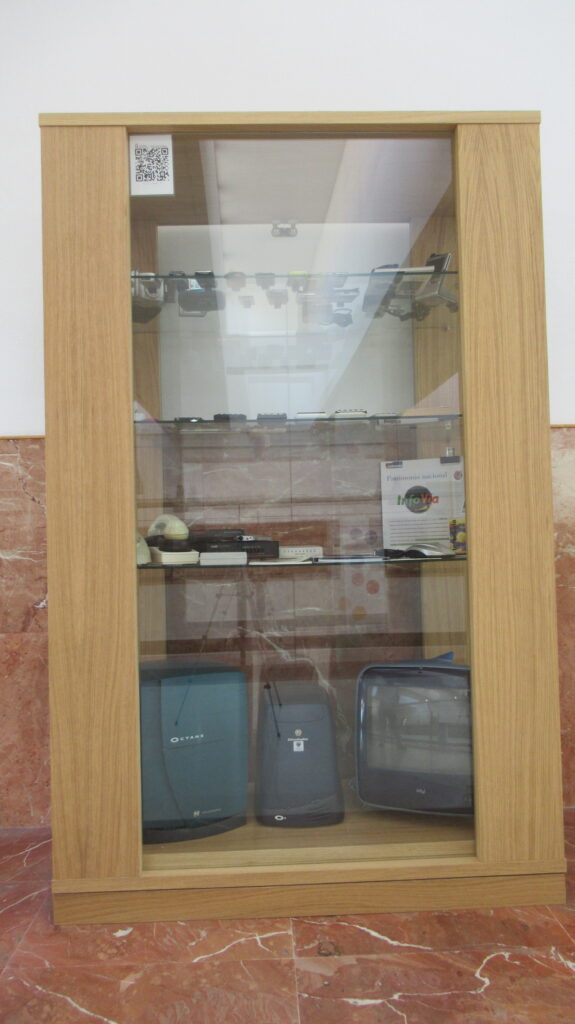
In this display case you’ll find various phones and PDAs, calculators, modems, and other devices for connecting to the internet. There are also a couple of Silicon Graphics workstations, as well as “Paquito,” a peculiar internet computer from the late 1990s.
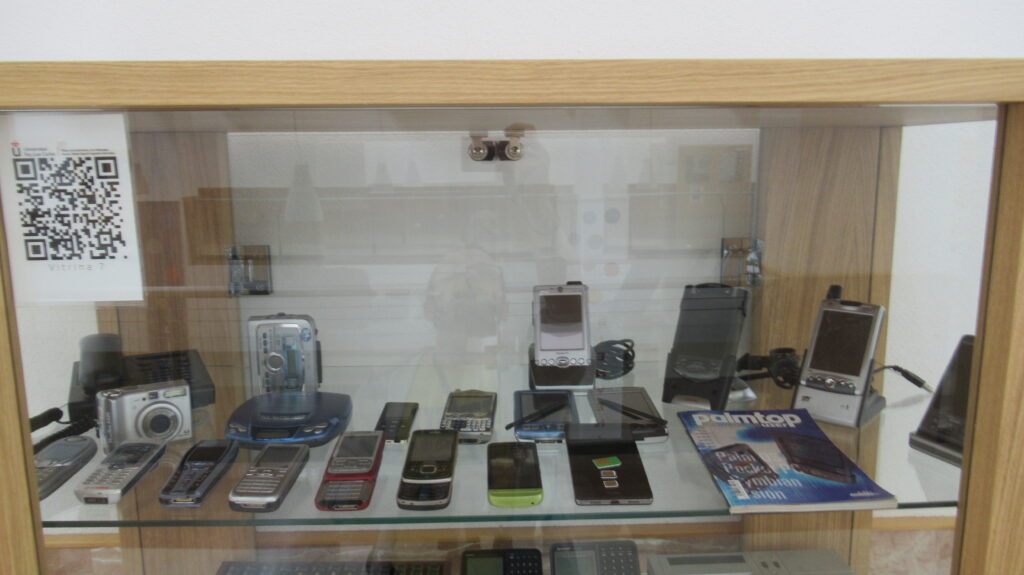
The top shelf displays various seemingly unrelated objects. To begin with, on the right side of the shelf, we can see several PDAs, short for “Personal Digital Assistants.” These are electronic organizers, some mounted on their charging cradles and others without, controlled with a stylus or pointing device. They allow users to manage a calendar, connect to the internet to answer emails, and organize their work life wirelessly. Next to these organizers, we find the first issue of the specialized magazine “Palmtop User,” published in January 2003, which was later renamed “PDA User.” We can also find an Aiwa Walkman (1999), a Sony Discman (2000), and an MP3 player (date unknown, but from around the early 2000s). There is also a 4-megapixel Canon digital camera (2004). The remaining items are telephones, starting with a landline and then countless mobile phones of different types and sizes. We can also see three SIM cards of various sizes (mini, micro, and nano).
We wanted to show the convergence of all these products (calendar, music player, camera, and telephone) into a smartphone, which is essentially a pocket computer. Our mobile phones today do everything, and perhaps the least common use we have for them is making calls.
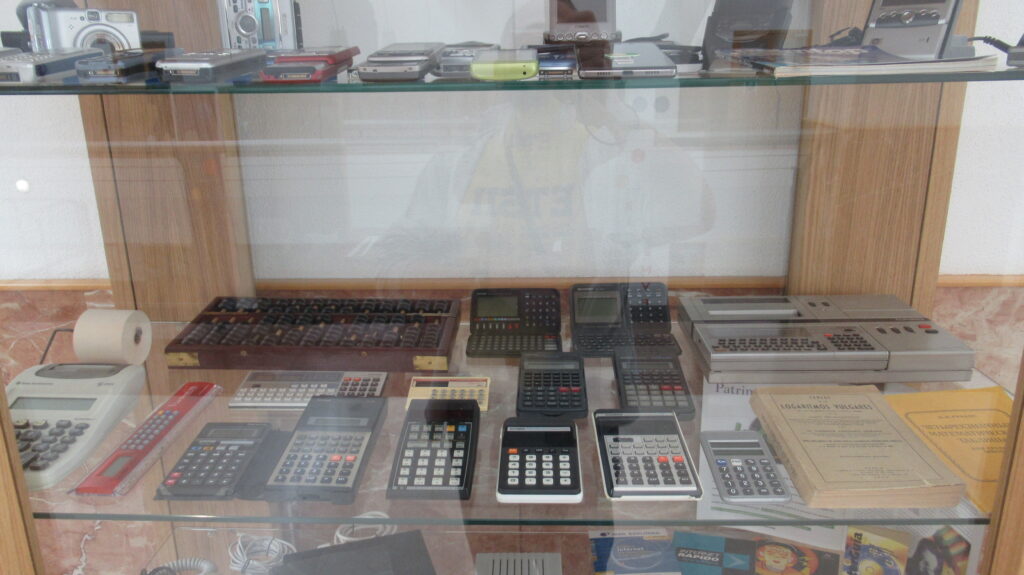
The second shelf from the top is our tribute to the world of mathematics and calculation techniques. In the background on the left, we can highlight a Chinese abacus, or “suanpan.” The abacus is an ancient instrument. The first mention of an abacus in China dates back to the 2nd century BC, although it is believed that it was not invented there and that the Sumerians were already using it in the 3rd millennium BC. The Chinese version shown here consists of a series of rods with beads, 5 on one end and 2 on the other. The beads in the group of 5 can be moved from one end of the rods to the other to represent the numbers 1 through 5, while the beads grouped in pairs represent 5. Each rod represents a digit: units, tens, hundreds, etc. Using simple manipulation rules, quite complex arithmetic calculations can be performed with the abacus.
At the back of the display case, in the centre, we have two more electronic organizers, foldable in format, with a keyboard and LCD screen. We placed them here and not on the top shelf because they look more like calculators than PDAs.
At the back on the right, we have a very interesting object. It’s a Casio Personal Computer PB-700 calculator connected to a Casio Personal Computer FA-10 (1984). In other words, it’s a calculator that has been attached to a module that integrates a printer. Next to the abacus is a smaller calculator of the same type, the PB-100 model.
The rest of the shelf’s components are calculators of all kinds, from the simplest with basic operations, to an automatic peseta-to-euro converter and a calculator tablet, as well as scientific calculators. Of particular note is the 1979 HP-34C calculator (in the foreground, in the centre of the shelf).
Finally, on the right-hand side, we find two books of mathematical tables. On one side, we have a book of logarithms and trigonometric functions from 1964. On the other, we find a copy of Bradis’s 4-digit mathematical tables (1988 edition), written in Russian and widely used in the Soviet Union.
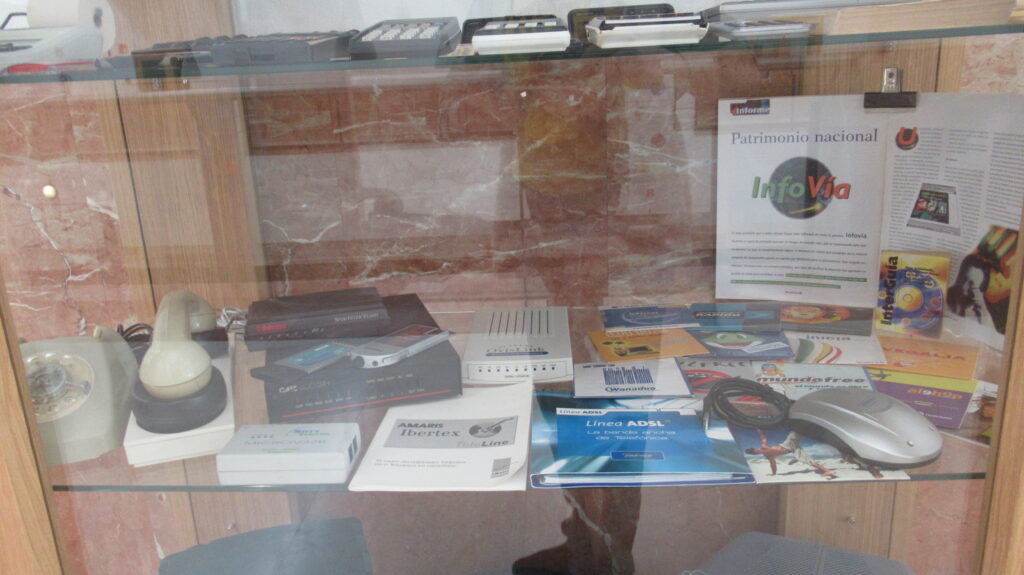
The second shelf from the bottom takes us into the world of computer networks and the Internet. To begin, on the left side of the shelf, we find a classic rotary dial telephone with an Epson CX-21 acoustic coupler. This coupler allowed computer-generated sound signals to be sent or received over the telephone network.
Next to it, we can see various modems of different sizes and transmission speeds, from the “giant” Case Communications 400/24+ to a couple of wireless modems for use with laptops. On the right side of the display case, we find a Telefónica ADSL router from 2004.
In the back right corner we have displayed issue number 1 of the magazine «Netmaní@» (1996), open to an article about «Infovía», a Telefónica network parallel to the Internet that was in force from 1995 to 1998 and was the successor to Ibertex.
To finish this shelf, on the right-hand side, we can see a series of CD-ROMs for internet connection and flat-rate plans from the late 1990s or early 2000s. They come from the period when Telefónica’s monopoly as an internet provider ended, leading to a proliferation of companies vying for users during the dot-com bubble, most of which have since disappeared. Among them are eresMas, Jazztel, Ya.com, MundoFree, Wanadoo, Uni2, Inicia, Jumpy, Alehop, and Navegalia.
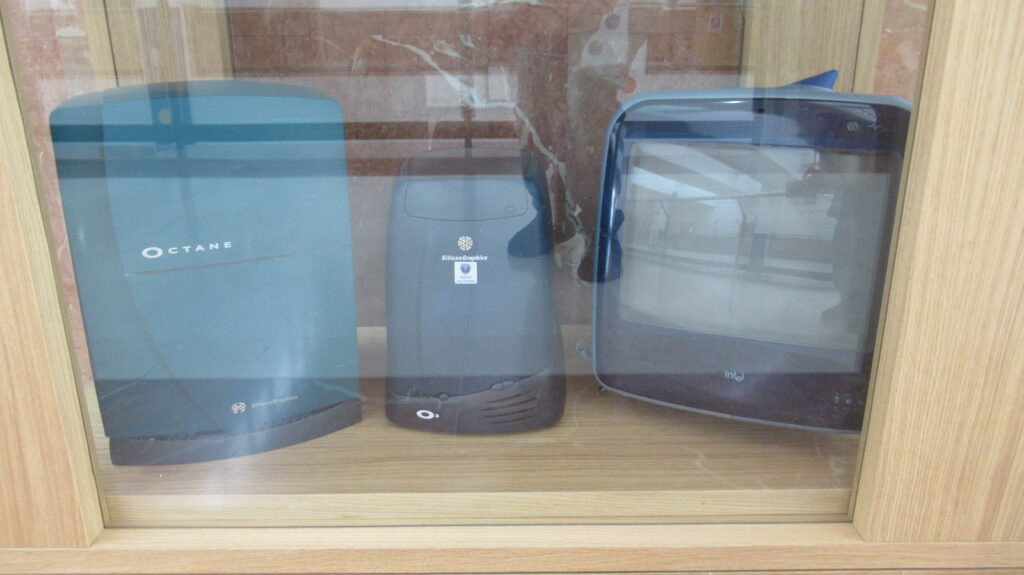
Finally, on the bottom shelf we find three computers with very different characteristics. On the left, we find two Silicon Graphics workstations, a blue-green Octane from 1997 and a blue O2 from 1998, with great computing capabilities and based on a MIPS processor.
On the right side of the shelf, we have an Intel Dot.Station 2300, an internet terminal from 2001 that can hardly be called a “computer” due to its limited capabilities (it could easily be called a dumb PC). The 2300 was inspired by Apple’s iMac (see the next display case), characterized by its rounded shape and running the Macintosh operating system. This is why, in a colloquial way, the 2300 began to be called “Paquito” (same syllables and vowels as Macintosh, but pronounced with a Spanish accent). However, the 2300’s design was closed and very limited: it only had 64 MB of RAM, the software couldn’t be updated nor could new programs be installed, and it was only good for connecting to the internet, viewing photos, and little else. Interestingly, it could also make phone calls, as can be seen with the handset resting on top. This product was offered to customers of what was then called Banco Santander Central Hispano, customers who wisely rejected it as it was more of a subcomputer.
Below, we list the detailed contents of each shelf in this display case:
| * Canon PowerShot A520 digital camera * Aiwa HS-TX596 Walkman * Sony D-E201 Discman * MP3/MP4 music player * Cisco CP-3905 landline phone * Sony Ericsson T230 mobile phone * Siemens S45 mobile phone * Nokia 7250i mobile phone * Nokia 6234 mobile phone * Nokia E65 mobile phone * Nokia N85 mobile phone * Nokia C5 mobile phone * Huawei P8 lite mobile phone * 3 SIM cards of different sizes (the green one is from Amena, from the early 2000s, and the other two are from Orange) * Palm Zire 71 PDA, with a style * HP iPAQ X09-50650 PDA, with a style * Dell Axim Pocket PC PDA, mounted on its base * Compaq iPAQ Pocket PC PDA, mounted on its base * HP iPAQ rx3000 PDA, mounted on its base * LOOX Pocket PC PDA Fujitsu, mounted on its base * palmOne Treo 650 PDA * “Palmtop User – The magazine specializing in PDAs and communicators” magazine (number 1, January 2003) |
| * Chinese abacus (suanpan) * Book “Table of Common Logarithms and Trigonometric Lines” (1964) * Book “Mathematical Tables of 4-Digit Bradys” (in Russian) * HP-34C Calculator * Casio Personal Computer PB-100 Calculator * Casio Personal Computer PB-700 Calculator connected to a Casio Personal Computer FA-10 * Sharp ZQ-3250 Electronic Organizer 64 kB * Casio SF-4100 Digital Diary Calculator * Texas Instruments SuperView Calculator (2004) * Casio fx-570S-W Calculator * Casio fx-82SX Calculator * Casio fx-82C Calculator * Casio M-1 Calculator * Casio fx-31 Calculator * Casio DC-160 Calculator with Case * Co-Diovan 320 Rule Calculator * Super Mini Ballpen SHH VAS 840 Calculator * Euro-peseta converter Calculator |
| * Rotary dial telephone with handset mounted on the Epson CX-21 acoustic coupler * Microv32B 14.4 kbps modem * OvisLink 56 kbps modem * Case Communications 400/24+modem * US Robotics Sportster Flash modem * Ericsson Mobile Office GC25 GSM Data Card * OfficeConnect Wireless 11g Access Point card * Amaris Ibertex Teleline manual * Telefónica ADSL USB router, with manual “ADSL Line – Telefónica’s Broadband” * Flat-rate internet connection kits from various companies (from front to back): Telefónica, Wanadoo, Jazzfree, Mundofree, Alehop, eresMas (“Fast Internet” and “I am a traveler”), Uni2, Jumpy, Inicia, Navegalia, Iber Explorer, Ya.com * “Netmaní@” magazine (number 1, 1996), opened with an article on “Infovía” * InterGuía – updated guide Organized by topic with over 500 annotated web addresses (1996) |
| * Silicon Graphics O2 workstation * Silicon Graphics Octane workstation * Intel Dot.Station 2300 internet terminal computer, colloquially known as “Paquito” |